A Beekeeper Explains What the Label Actually Tells You
I run 30 hives in the rural South. I pull honey off the comb, strain it through mesh, let it settle, and bottle it myself.
Every jar I sell comes from one place. I can tell you what was blooming when the bees made it.
Amazon cannot tell you that about either of its house brand honeys.
The labels tell the story.
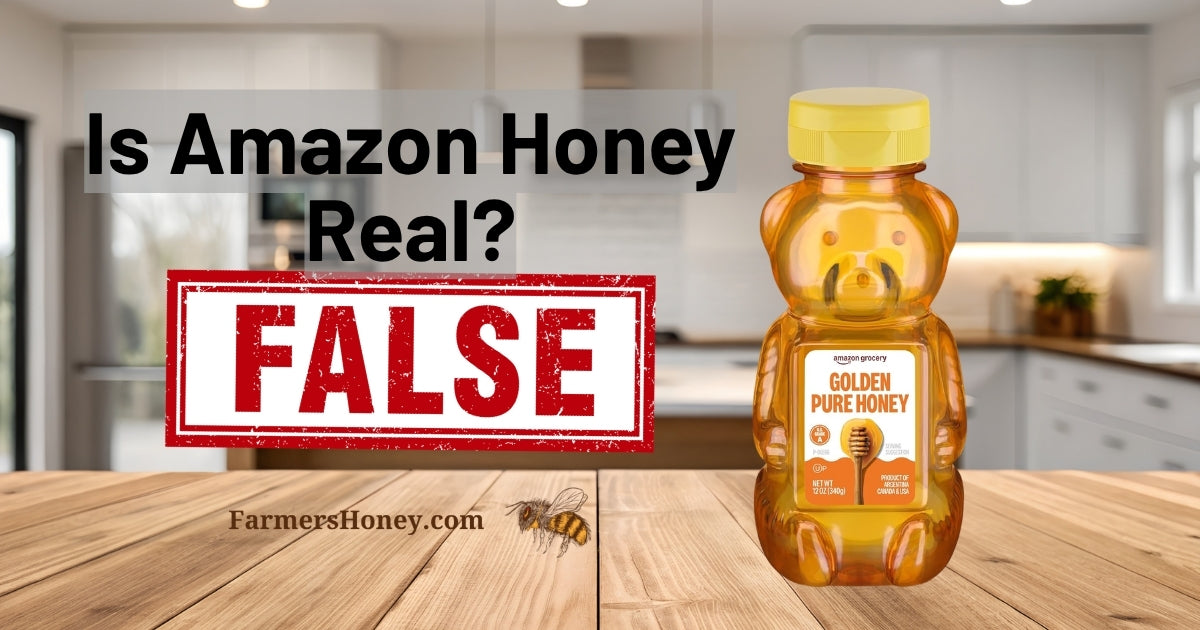
The 12 ounce Amazon Grocery bear bottle says Product of Argentina, Canada and USA.
The 24 ounce Amazon Saver bottle says Product of Argentina, Uruguay and India.
Both say U.S. Grade A.
Neither is sold as raw honey.
Two bottles. Five countries between them. One bottle contains no American honey at all.
None of this is hidden. Amazon printed it on the label. You just have to read it.
So is Amazon honey real?
Yes, it is sold as honey, and I have no evidence that it contains anything else.
But that is not the whole story.
The real question is what kind of honey you are buying.
What Does Product of Argentina, Uruguay and India Mean?
It means the honey did not come from one place, one beekeeper, or one harvest.
Large packers buy honey from suppliers around the world. Honey from different countries is blended together to create a product that looks and tastes about the same every time you buy it.
That consistency is the goal.
Real honey is naturally inconsistent.
Spring honey tastes different from summer honey. Honey from one farm can taste completely different from honey produced ten miles away. The flowers change. The weather changes. The season changes.
That is what gives honey its character. My own raw wildflower honey is never quite the same from one harvest to the next, and that is the point.
A blend from several countries is made to taste consistent. It is not made to taste like a particular place.
The Amazon Saver bottle lists Argentina, Uruguay and India.
There is no American honey in it.
That does not make it illegal or fake. It simply means the honey was produced somewhere else, shipped into the United States, blended, bottled and sold under Amazon's name.
The label is honest about that.
Same question came up with Walmart honey, and there the label said Product of USA. That is a real point in its favor.
Does Honey From India Mean It Is Fake?
No.
India produces real honey and legally exports large amounts of it.
There is no evidence that Amazon's honey is fake, illegally imported or falsely labeled.
There is, however, a reason people in the honey business pay attention to origin.
Federal prosecutors have handled major cases involving Chinese honey that was shipped through other countries and falsely declared as coming from places such as India and Malaysia. One investigation involved allegations that more than $180 million in antidumping duties had been avoided. A Texas honey broker later received three years in federal prison for brokering Chinese honey that was misrepresented as Indian or Malaysian honey.
None of those cases prove anything about the honey Amazon sells today.
The point is traceability.
The farther honey travels and the more companies involved, the more you have to depend on paperwork to know where it came from.
When you buy honey from the beekeeper who produced it, the supply chain is pretty simple.
The bees made it.
The beekeeper bottled it.
You bought it.
What Does U.S. Grade A Actually Mean?
Both Amazon bottles say U.S. Grade A.
Most people see that and assume it means the honey is American, raw or minimally processed.
It means none of those things.
U.S. Grade A is a USDA quality standard for extracted honey. It considers moisture, flavor and aroma, absence of defects and clarity.
It does not tell you that the honey is raw.
It does not tell you that it came from the United States.
It does not tell you that it came from one beekeeper.
It does not tell you how much heat or filtration was used.
The USDA grade standards are also voluntary. The words U.S. Grade A do not automatically mean a federal inspector personally tested the bottle you are holding.
That is how a bottle produced in Argentina, Uruguay and India can still say U.S. Grade A on the front.
The same stamp sits on the Kirkland bottles at Costco. It does not tell you which one was treated more gently.
Grade A describes certain qualities of the finished honey.
It does not describe where it came from or how close it is to what came out of the hive.
Is Amazon Honey Raw?
No.
Neither Amazon house brand honey is marketed as raw.
Costco at least puts a Kirkland Raw Unfiltered version on the shelf, though raw is a loose word on any label.
The Amazon Grocery bottle says pure honey.
Pure and raw do not mean the same thing.
Pure tells you the product is honey without other sweeteners listed on the label.
It does not tell you whether the honey was heated.
It does not tell you how finely it was filtered.
It does not tell you how long it sat in storage.
It does not tell you how many different producers contributed to the blend.
Amazon does not publish detailed processing information for these bottles, so I am not going to pretend I know the exact temperature or filtration method used.
What we know for sure is printed on the label.
The honey comes from several countries.
It is blended into one product.
It is not sold as raw.
That is enough information to understand what you are buying.
Does Amazon Honey Crystallize?
It can.
Real honey naturally crystallizes. Some honey crystallizes within weeks. Some stays liquid for months or longer.
It depends on the nectar source, the natural balance of sugars and the storage temperature.
Crystallization does not prove that honey is raw.
Honey can be warmed, filtered and commercially packed and still crystallize later.
Honey staying liquid does not automatically prove it is fake either.
There are plenty of internet tests claiming to prove whether honey is real. Most of them are useless.
The label, the source and the reputation of the producer tell you more than dropping honey into water or watching whether it crystallizes.
What Is the Real Difference?
Taste.
I have tried plenty of grocery store honey. Costco honey. Walmart honey. Organic honey. Imported honey. Even single source honey such as orange blossom and buckwheat.
The difference between a generic blend and honey bottled by a beekeeper is not hard to taste.
Real honey is not just sweet.
It tastes like something.
Spring honey in the South can be light and floral. Later honey may be darker, richer and stronger. One harvest may taste like clover. Another may carry blackberry, privet, tulip poplar or whatever else was blooming nearby. That mix is what raw wildflower honey actually is.
That flavor comes from bees working a specific patch of ground during a specific part of the year.
You cannot recreate that by averaging honey from several countries together in a tank.
You can make it consistent.
You can make it clear.
You can make it convenient.
You cannot make it taste like a place.
The Bottom Line on Amazon Honey
Amazon honey is real honey as far as the label shows.
It is also a blended global commodity product.
Those two things can both be true.
The Amazon Grocery bottle contains honey from Argentina, Canada and the United States.
The Amazon Saver bottle contains honey from Argentina, Uruguay and India.
Neither bottle is sold as raw honey.
U.S. Grade A does not change any of that.
Amazon deserves credit for putting the countries of origin on the label. The information is there.
Read it before you buy.
You can buy honey blended from several countries and packed to taste the same every time.
Or you can buy raw wildflower honey from a beekeeper who knows exactly where it came from.
They are both sold as honey.
They are not the same product.
Compare Other Grocery Store Honey
Amazon is not the only company selling house brand honey.
I also broke down the labels and sourcing behind Costco Kirkland honey and Walmart Great Value honey.
The answers are not identical.
Turn the bottle around wherever you shop.
Where to Buy Real Raw Honey
I sell raw honey pulled from my own hives in the rural South.
I let the bees work it until the comb is fully capped and ready to harvest.
I extract it into a tank through a 400 micron filter one time.
I let it settle.
Then I put it into jars.
Never heated.
Never finely filtered.
Never blended with honey from other countries.
One country.
One farm.
One set of hives.
If you want honey that tastes like actual flowers from an actual place, take a look at my latest raw honey harvest.
